Showing posts with label Storyboarding. Show all posts

Tuesday, March 8, 2011

Storyboards: The Man Who Shot liberty Valance, part 7

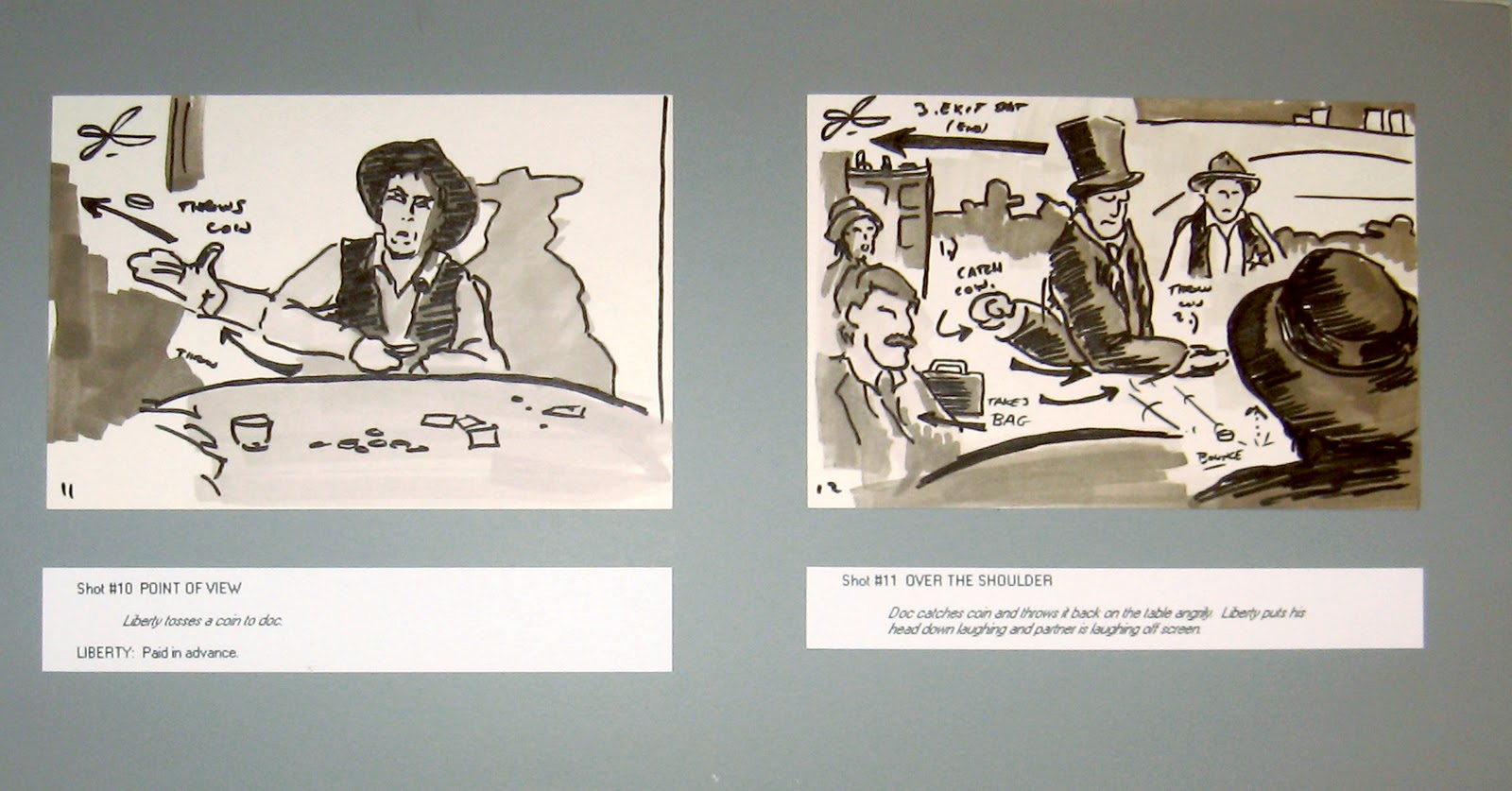
Here we go with two more panels of the Liberty Valance boards!

The beginning of another ongoing gag in these. The Sherriff, Link Appleyard, played in the film by the great Andy Devine, grows in every panel in which he appears.
This is the kind of gag you can get away with in any of three conditions.
1. A classroom setting with a forgiving teacher, one who would rather encourage creativity than squelch it.
2. Working with a client you know VERY well.
3. Working on a broad comedy.
Luckily for the students, one of the three applied here!
Pretty straightforward content. Again, the use of the term "point of view" is ambiguous.
Next, for variety, a different kind of student work.

Tuesday, February 22, 2011

Students Teaching Students

Something a bit different, in the name of variety.
Every summer for the past 11 years, I've been graced to teach in the MCAD program known as Summer Expressions Seminar (SES). I've not heard yet if I have the appointment for this year, but I have hopes.
In 2010, I added a wrinkle to the assignment in my class, which is the Liberal Studies portion of the college prep program. In the past I've had them storyboard less common fairy tales.
This time, I also had them work in one another's disciplines and teach one another. For example, a painting student would work with a comic artist, or an animator, or a gamer.
The point of this was to help them understand their own craft and to communicate that craft to one another.
You learn by teaching.
Here are some panels from one of the more successful pairings.


The students, Taylor Smith and Sarah Williams, bought their own styles to the work and advacned the story at the same time.
Inspiring!
It also serves to make the point that every discipline, including storyboarding, is much more flexible than many teachers would have it be. The boards presented here from college level courses are very professional, but that has its down side when teaching the novice. A good teacher will find a way to encourage students into growing into a desired result, not to browbeat them into doing the work in one regimented way. This assignment is an attempt to recognize that and encourage both professionalism and a sense of freedom and accomplishment.

Sunday, February 20, 2011

Storyboards: The Man Who Shot liberty Valance, part 6

I've not taught studio for a while, and so have neglected this blog. As I have a backlog of material and hope to have more soon, it seems a good time to pick it up again. My apologies to the faithful readers. I will make amends for my absence, starting now!
Here's the next frame of the Liberty Valance storyboards.
Again the definition of the shot as "over the shoulder" is a bit vague. Looking at the depth of field, I'd be tempted to just go "long shot" on this one. It's a fairly static camera.
What's noteworthy here are the stage directions. The doctor throws the chip and it bounces on the table. This is clear both in the caption and in the image.
Once again, I love the tones of those French gray markers!
Working backwards affords a luxury that a storyboard artist doesn't have in a real-world environment. It's not your job to block out all character and camera motion, though understanding these things is crucial.
It's your job as a storyboard artist to apply images to the words of the script. That's it.
But to really know how to do that, you must understand both the theory and practice of filmmaking. This is problematic. The language used on a shoot is often quite different than that used in classes. And all these languages evolve over time.
So which language do you use? You use the one that best suits the needs of the director with whom you are working.
Terry Gilliam often does his own boards. On Brazil, his boards were little more than thumbnails. But as he is the director and he knows what he means, that's sufficient.

Tuesday, May 18, 2010

Storyboards: The Man Who Shot Liberty Valance, part 5

Okay, I got busy teaching and have neglected this blog for far too long. Now that I'm catching up on my work, I can take time to correct the situation.
Here's the first part of Board 2 of The Man Who Shot Liberty Valance.


Again, the clean sharp line, just enough detail in the background, a concept I have issues with in my own work. I quibble with the definition of shot 9. Yes, it is an OTS shot, but I don't see that as its primary function.
Look what's happening here. The primary point of the shot is that the character moves but the camera does not. I would define this as a group shot, or by distance, a MLS, also known as a Cowboy shot (cowboys were shown from the waist up in TV shooting because they couldn't ride and were sitting on a saddle over a barrel).
I like the warmth of the French gray markers.
Students who lacked experience with hand skill based art would ask me constantly if they could do their storyboards digitally. Once, I relented, and the results were awful. For this kind of work, especially at this level, the best ways of working are either all hand work or a hybrid.

Sunday, December 13, 2009

Storyboards: The Man Who Shot Liberty Valance, part 4 and whole board 1

The conclusion of the first board. I will speed up posting these, as at this rate, it will take me more than two months to do the whole thing!


It takes a bit of decoding, but it's possible to follow every move from these boards. The recurring problem is the overuse, sometimes inaccurate, of the term "full shot", which refers to a full-figure shot, also called a long shot.
Here's all of Board One.


Next week, the top tier of Board Two.

Saturday, December 5, 2009

Storyboards: The Man Who Shot Liberty Valance, part 3

More about this assignment:
After viewing the entire film, the students pick one scene of at least 5 minutes and prepare a full-pasteup board. This board shows every camera, character and object motion. It also documents every sound in the film. Essentially, they are dissecting a well-made film as a learning tool.
There is a facile aspect to this. I've been on enough shoots to know that the anlaytical aspects are often instinctive during the shoot, so looking at filmmaking form a theoretical viewpoint does not always apply. However, it's still useful to look at shot composition and continuity.
There are some technical errors on these boards, but most are minute. The most galring error is the misspelling of Rance Stoddard's name in the captions. Aside from having access to imdb.com, a source of record for film information, the students could have watched the movie more carefully, as the name is spelled out in big letters on screen in the story!
Ah well. A small concern, but one that would be embarrassing in a story meeting.
This week's panels:

Friday, November 27, 2009

Storyboards: The Man Who Shot Liberty Valance, part 2

These are the last two panels of the top tier of the first board. There are eight or nin boards in all.
The assignment was to deconstruct a scene from a classic film. Every action, object motion and sound was to be documented.
The clip had to be at least 5 minutes long, unless an exceptionally elaborate scene was chosen.
Left to their own devices, students will usually go for the most glamorous scene, the scene with the highest energy. Usually I try to back them away from such amibitions just a bit, but with Josh Purple on board, I thought "hm... maybe they can pull this off after all."
When the panels of each board have all been posted, the board will be posted as a unit.

Tuesday, November 24, 2009

Storyboards: The Man Who Shot Liberty Valance, part 1

This one goes back quite a ways. This was the first truly successful project from one of my college-level storyboard classes. It is not without its problems, but given the subtleties and complexities of some of the  material, these guys just shined.
The team was Kelahir Johnson, Josh Purple, Ryan Fogarty, and Jason Tordsen, I believe.
More on their current activities in a later post.
Here are the title card and panel one from this very elaborate board.


I will have much more to say about the challenge of this project and how these students rose to it over the next few weeks!